Orthodox Glossary of Terms
Use this practical guide to the language of Orthodox Christian faith, church services, icons, baptism, marriage and Greek family traditions. Whether you are visiting a parish, preparing for a celebration or choosing a meaningful gift, start with a word you have heard and follow its related entries.
Greek words have several English spellings. Local customs and service arrangements also differ: your parish priest is the right person to confirm what applies to your family. Dates below refer to the Church’s liturgical calendar; some communities observe a different corresponding civil date.
JUMP TO A LETTER
Quick starting points: Baptism · Icon · Pascha · Stefana · Theotokos
A
Akathist
A hymn of praise traditionally prayed standing, often honoring Christ, the Mother of God or a saint.
Alithos Anesti
The Greek reply to Christos Anesti: “Truly He is risen.”
Altar / Holy Table
The consecrated table in the sanctuary where the Eucharistic gifts are offered.
Amen
An affirmation of prayer, commonly understood as “so be it.”
Anastasis
The Greek word for resurrection; in icons, often Christ’s victory over Hades.
Angel
A spiritual creature who serves God and carries out His will.
Anointing
Applying blessed oil or chrism in a particular rite. Baptismal oil, chrism and Unction have different uses.
Apostle
Someone sent to proclaim Christ. The title especially identifies the Twelve and Saint Paul.
Archangel
An angelic title associated particularly with Michael and Gabriel.
Archangel Gabriel
The heavenly messenger associated with the Annunciation to the Virgin Mary.
Archangel Michael
Honored as a leader of the angelic hosts and a defender against evil.
Arravona
Greek usage for betrothal. In the wedding service, the betrothal includes the blessing and exchange of rings.
Ascension
The celebration of Christ’s ascent to the Father, forty days after Pascha.
↑ Back to top
B
Baptism / Holy Baptism
Entry into life in Christ through water and the Holy Spirit, ordinarily celebrated with three immersions.
Baptism Candle
A candle accompanying the newly baptized, expressing the light of life in Christ.
Baptism Cross
A cross received at baptism and often worn afterward as a sign of Christian belonging.
Baptismal Font
The vessel containing the blessed water used for baptism.
Baptismal Garment / White Garment
The new white clothing associated with being clothed in Christ after baptism.
Baptismal Name
The Christian name associated with a person’s reception into the Church, often honoring a saint.
Basil / Vasilikos
An aromatic plant used in some blessings and customs connected with the Holy Cross.
Betrothal
The opening wedding rite involving rings. See Arravona .
Bishop
An ordained successor of the Apostles who oversees a church community and ordains clergy.
Blessing
A prayer asking God to sanctify, guide or care for a person, place or activity.
Bomboniere / Boubouniere
Celebration favors familiar in Greek wedding and baptism customs, often containing sugared almonds.
Bright Week / Renewal Week
The week immediately after Pascha, marked by the joy of the Resurrection.
Bright Week Candle
A candle used during the Paschal celebrations. It is a devotional description, not a separate sacrament.
Byzantine
Associated with the Eastern Roman Empire and its enduring Christian artistic, musical and liturgical heritage.
↑ Back to top
C
Catechumen
A person learning the faith in preparation for reception into the Church.
Christ / Messiah
Titles meaning the Anointed One, identifying Jesus as the Savior promised by God.
Christian
A follower of Jesus Christ; Orthodox Christian life is lived in the Church’s worship and sacraments.
Chrismation / Holy Chrismation
Anointing with holy chrism through which the newly baptized receives the gift of the Holy Spirit.
Christos Anesti
Greek for “Christ is risen,” the joyful greeting of the Paschal season.
Church
The people united to Christ as His Body; the word also identifies their place of worship.
Church Candle / Orthodox Candle
A candle offered during prayer or worship as an expression of faith and devotion.
Church Fathers
Teachers recognized for faithfully expressing and defending the Church’s received faith.
Common Cup
Wine shared by the wedding couple as a sign of their life together; distinct from Eucharistic Communion.
Communion / Holy Communion
Receiving Christ’s Body and Blood. See Eucharist .
Confession
The sacrament of repentance and reconciliation with God, with the priest serving as witness and minister.
Confetti
In Italian celebration customs, sugar-coated almonds; compare Greek koufeta .
Cross / Life-Giving Cross
The sign of Christ’s saving Crucifixion and His victory over death.
Crown Case / Framed Crown Case
A keepsake container or display for wedding crowns; its style is a family choice.
Crowning
The wedding rite in which crowns are placed on the couple, expressing honor and sacrificial love.
Crucifixion
Christ’s death on the Cross, remembered especially on Great and Holy Friday.
↑ Back to top
D
Dance of Isaiah
The wedding procession around the table, accompanied by hymns including one addressing the Prophet Isaiah.
Deacon
An ordained minister who assists the bishop or priest in worship and service.
Diptych
A two-panel hinged icon. Liturgically, diptychs can also mean lists of names commemorated in prayer.
Disciple
A learner who follows Christ; the Twelve were His especially close disciples.
Divine Liturgy
The Church’s Eucharistic service, bringing together Scripture, prayer, thanksgiving and Holy Communion.
Dormition
The feast of the falling asleep of the Mother of God, celebrating her repose and glorification.
Dove
A symbol recalling the Holy Spirit’s manifestation at Christ’s baptism; the Spirit is not a bird.
↑ Back to top
E
Epiphany
A manifestation of God. In many Orthodox contexts, another name for Theophany .
Epitaphios
The sacred cloth depicting Christ laid in the tomb, venerated during Holy Week.
Eternal Life
Life in communion with God, whose fulfillment is the Kingdom to come.
Eucharist
The sacrament of thanksgiving in which the consecrated bread and wine are Christ’s Body and Blood.
Exaltation of the Holy Cross
A Great Feast honoring the Cross of Christ, observed on September 14 in the Church calendar.
↑ Back to top
F
Faith
Trust in God expressed through a life of prayer, love, repentance and obedience to Christ.
Fasting
A discipline joined to prayer and generosity, practiced with pastoral guidance and attention to personal circumstances.
Feast Day
A liturgical celebration of Christ, the Mother of God, a saint or a sacred event.
Filakto
A small devotional keepsake associated with blessed materials in some Greek customs; it should not be treated as magic.
Forerunner
The title of Saint John the Baptist, who prepared people to receive Christ.
↑ Back to top
G
Godchild
A baptized person in relation to the sponsor who helps nurture their Christian life.
A sponsor who professes the faith and supports the newly baptized in growing within the Church.
Golgotha / Calvary
The place of Christ’s Crucifixion in Jerusalem.
Gospel
The good news of salvation in Christ; also one of the four New Testament accounts of His earthly life.
Gospel Book
The liturgical book from which the Gospel is proclaimed in church.
Grace
God’s freely given presence and action, drawing us into healing, holiness and communion with Him.
Great Feast
One of the principal celebrations of the Church year; Pascha is celebrated above all as the Feast of Feasts.
Guardian Angel
An angel invoked in Orthodox prayer for protection and guidance.
Guardian Angel Icon
A sacred image of an angel, often chosen as a devotional reminder of God’s care.
↑ Back to top
H
Halo
The luminous circle used in sacred art to indicate holiness and participation in God’s glory.
Hanging Icon / Home Icon
An icon displayed at home for prayer; its placement and mounting are practical choices.
Heaven
The fulfillment of life with God, described through the hope of His Kingdom.
Hell
The fearful reality of rejecting communion with God; Orthodox teaching calls everyone to repentance and mercy.
Holy Doors / Royal Doors
The central doors in the iconostasis leading toward the altar.
Holy Light
The light received at the Holy Sepulchre during the Jerusalem Holy Saturday ceremony and shared with the faithful.
Holy Matrimony / Marriage
The sacramental blessing of a man and woman’s shared life in Christ.
Holy Mysteries / Sacraments
The Church’s sacred means of participation in God’s grace, including Baptism, Eucharist and the other sacramental rites.
Holy Oil
Oil blessed for a particular sacred purpose; baptismal oil, holy chrism and the oil of Unction are distinct.
Holy Saturday
The day commemorating Christ’s bodily rest in the tomb and His victory over Hades.
Holy Scripture
The Old and New Testaments, read and understood within the Church’s living Tradition.
Holy Spirit
The third Person of the Trinity, proceeding from the Father and worshiped with the Father and Son.
Holy Trinity
The one God: Father, Son and Holy Spirit, three Persons sharing one divine nature.
Holy Unction
The sacrament of anointing for healing of soul and body, accompanied by the Church’s prayers.
Holy Water
Water sanctified through prayer for blessing and devotional use.
Holy Week
The days leading to Pascha in which the Church follows Christ’s Passion, burial and victory.
Home Blessing
A priest’s visit to pray for a household, often including the sprinkling of holy water.
↑ Back to top
I
Icon
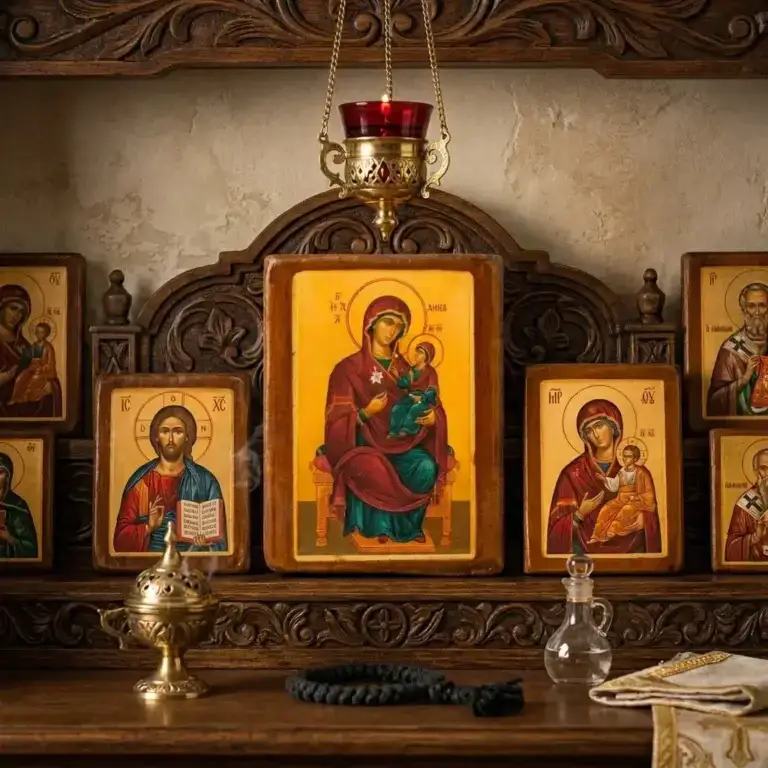
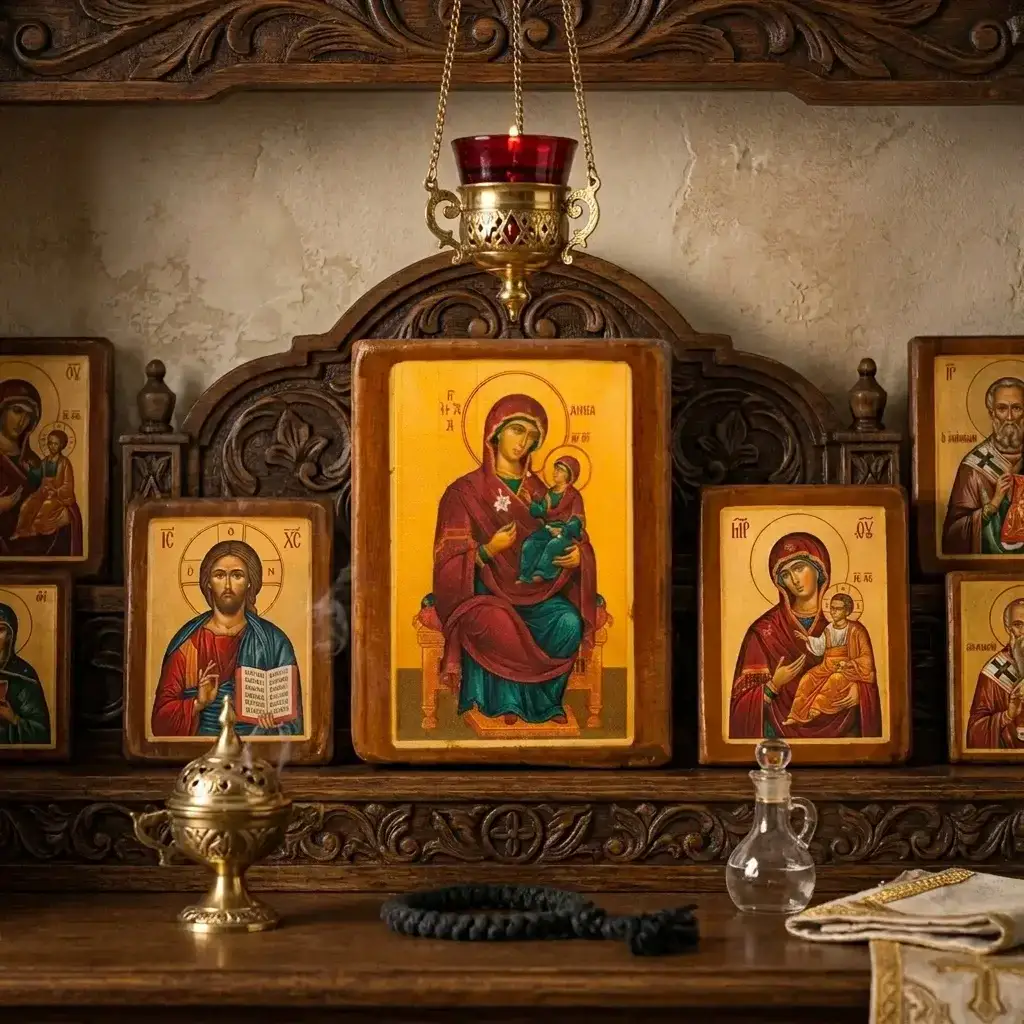
A sacred image of Christ, His Mother, the angels or saints, honored in relation to the person represented.
Icon Corner / Prayer Corner
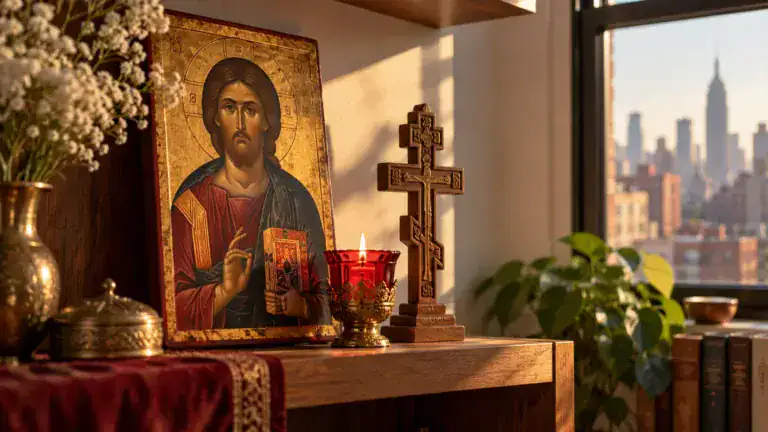
A place set aside at home for icons and regular personal or family prayer.
Icon Set
Two or more icons arranged together, often including Christ and the Mother of God.
Icon Stand
A support used to display an icon for prayer or veneration.
Iconography
The making and interpretation of sacred images within the Church’s artistic and theological tradition.
Iconostasis
The icon-bearing screen between the congregation and the sanctuary.
Incarnation
The eternal Son of God becoming truly human in Jesus Christ without ceasing to be divine.
Intercession
Prayer for another person, including the prayers Christians ask of the saints.
Ioanna / Yianna
Greek feminine forms associated with the name John; the particular patron saint should be identified personally.
Ioannis / Yiannis / Yianni
Greek forms of John, a name shared by several saints, including the Baptist and the Evangelist.
↑ Back to top
J
Jerusalem
The city of Christ’s Passion and Resurrection, and a major destination for Christian pilgrimage.
Jesus Christ
The eternal Son of God, fully divine and fully human, whose life, Cross and Resurrection bring salvation.
Jesus Prayer
A short invocation of Jesus Christ for mercy, often repeated with a prayer rope.
Jordan Almond
A sugar-coated almond used in celebration favors. See Koufeta .
Jordan River
The river where Saint John baptized Christ, remembered at Theophany.
↑ Back to top
K
Kingdom of Heaven
God’s reign and the fullness of communion with Him, anticipated in the Church’s life.
Komboskini / Chotki
Greek and Slavic names for a knotted prayer rope .
Koufeta
Sugared almonds offered in Greek wedding and baptism favors; their customary symbolism varies among families.
Koumbaro / Koumbara
The male or female wedding sponsor in Greek usage, whose role includes supporting the couple’s life of faith.
Kouvouklion
The decorated structure associated with the Epitaphios and Christ’s tomb during Holy Week.
Kyrie Eleison
Greek for “Lord, have mercy,” a frequent response in Orthodox services.
↑ Back to top
L
Ladopana / Ladopana Set
Baptismal cloths, towels and related white textiles. Exact set contents and parish requirements vary.
Lambada / Lambatha
Greek for a large candle; commonly used for baptism or Paschal celebrations, depending on context.
Lambathes / Lambades
Plural forms for candles, including those associated with Greek wedding and Paschal customs.
Lent / Great Lent
The principal period of fasting and repentance before Holy Week; other fasting seasons also shape the year.
Liturgical Year
The yearly rhythm of feasts, fasts and commemorations, beginning on September 1 in the Church calendar.
↑ Back to top
M
Martyr
A witness to Christ who remains faithful even when that witness leads to death.
Martyrika / Witness Pins
Small baptismal remembrance pins or bracelets used in some Greek communities; styles are customary rather than universal.
Matins / Orthros
The Church’s morning service of psalms, prayers and hymns.
Miracle
An extraordinary manifestation of God’s action and mercy, received with discernment rather than treated as a guarantee.
Monastery
A community where monks or nuns pursue prayer, worship, work and life together.
↑ Back to top
N
Name Day
The commemoration of the saint associated with a person’s Christian name.
Narthex / Vestibule
The entrance area of a church, before the main space of the congregation.
Nativity
Christ’s birth, celebrated on December 25 in the liturgical calendar; the corresponding civil date varies by calendar.
Nave
The main body of the church where the congregation gathers.
Nouna / Nouno
Familiar Greek words for godmother and godfather.
↑ Back to top
O
Oil Bottle
The container brought for oil used in a baptism; a bottle alone does not make its contents blessed.
Orthodox
Commonly rendered as right belief or right worship; the name identifies the Eastern Orthodox Christian tradition.
Orthodox Christian
A member of the Orthodox Church who shares its faith and sacramental life.
Orthodox Church
The communion of local churches preserving the apostolic faith and sharing the same sacramental life.
Orthodox Faith / Holy Tradition
The life and teaching handed on in the Church, expressed in Scripture, worship, councils and the witness of saints.
Orthodox Wedding Candle
A candle used in the marriage service, expressing the couple’s calling to live in Christ’s light.
↑ Back to top
P
Palm Sunday
The celebration of Christ’s entry into Jerusalem, immediately before Holy Week.
Panagia
A Greek title meaning All-Holy, used for the Mother of God; also a bishop’s devotional medallion.
Parish
A local worshiping community under its bishop, ordinarily served by a priest.
Pascha
The celebration of Christ’s Resurrection, at the center of the Orthodox liturgical year.
Paschal Candle
A candle associated with the celebration and proclamation of the Resurrection.
Paschal Greeting
The exchange “Christ is risen” and “Truly He is risen,” spoken in many languages.
Paschal Hymns
The Church’s hymns proclaiming Christ’s victory over death during the Resurrection celebrations.
Paschal Season
The festal period following Pascha, with its forty-day celebration culminating in the Ascension.
Patron Saint
A saint with whom a person or community has a particular relationship of prayer and remembrance.
Pentecost
The feast of the Holy Spirit’s descent upon the Apostles, fifty days after Pascha.
Pilgrimage
A journey to a holy place undertaken for prayer, thanksgiving or spiritual renewal.
Prayer
Turning toward God in thanksgiving, praise, repentance, petition and attentive silence.
Prayer for the Newly Baptized
Prayers asking God to strengthen and preserve a person in the new life received at baptism.
Prayer Rope
A knotted cord used to help maintain attention and rhythm in repeated prayer.
Priest
An ordained presbyter who serves the community through the sacraments, teaching and pastoral care.
Priesthood / Holy Orders
The Church’s ordained ministry; its principal orders are bishops, priests and deacons.
Procession
Prayerful movement of clergy and faithful, sometimes carrying icons, candles, the Gospel or the Epitaphios.
Prostration
A full bodily bow to the ground expressing repentance and reverence.
↑ Back to top
R
Redemption
Christ’s saving work freeing humanity from bondage to sin and death.
Repentance / Metanoia
A change of heart and direction toward God, made visible in a changed life.
Resurrection
Christ’s rising bodily from death, the foundation of Christian hope.
Resurrection Liturgy
The Divine Liturgy of Pascha, celebrated after the proclamation of the Resurrection.
↑ Back to top
S
Saint
A person whose holiness in Christ is recognized and celebrated by the Church.
Salvation / Theosis
Healing and transformation in Christ, culminating in participation by grace in God’s life.
Seal of the Gift of the Holy Spirit
The liturgical formula accompanying anointing with chrism in Chrismation.
Sign of the Cross
A bodily prayer invoking the Trinity; in common Eastern Orthodox practice, forehead, chest, right shoulder, then left.
Sin
A departure from God’s will that wounds communion with Him and with other people.
Solea
The raised area immediately in front of the iconostasis.
A spiritual supporter at baptism or marriage; the specific responsibilities differ between the two sacraments.
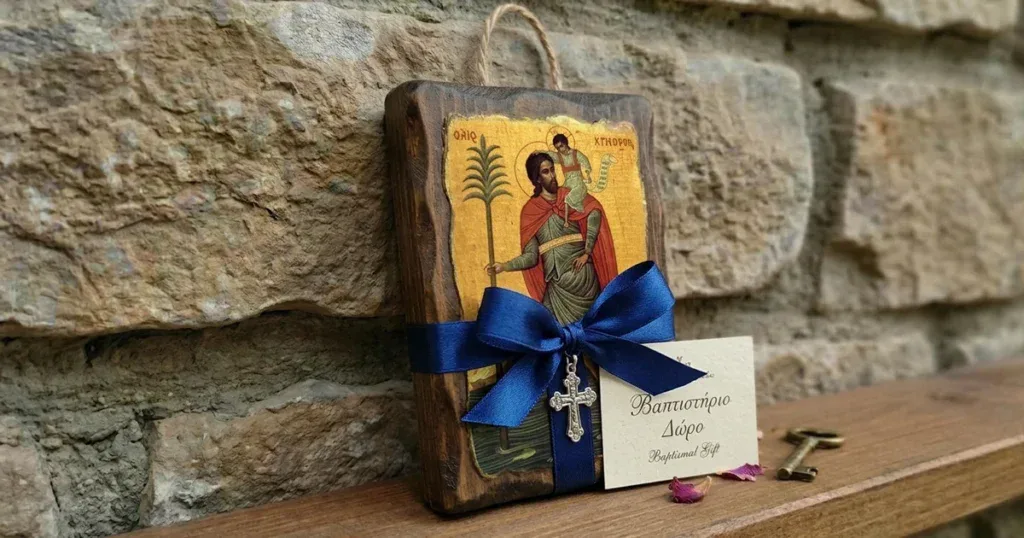
Saint Christopher
A martyr especially associated in popular devotion with prayer for travelers.
Saint Constantine
The Roman emperor honored with Helen as Equal to the Apostles; his reign helped end Christian persecution.
Saint Helen
Constantine’s mother, traditionally associated with the finding of the Cross in Jerusalem.
Saint John the Baptist / Forerunner
The prophet who prepared the way for Christ and baptized Him in the Jordan.
Saint Nicholas
The bishop of Myra remembered for generosity, pastoral care and help for those in distress.
Stavros / Stavroula
Greek names associated with the Cross; Stavroula is a feminine form.
Stefana / Wedding Crowns
The pair of crowns used in Orthodox marriage, expressing glory, shared responsibility and self-giving love.
Stefanothiki
A case for preserving the stefana after the wedding.
Sunday of Thomas / Antipascha
The Sunday after Pascha, remembering the risen Christ’s appearance to Thomas.
Superstition
Treating objects or rituals as automatic control over events, rather than placing trust in God.
Synaxis
An assembly for worship; also a commemoration connected with a preceding feast.
↑ Back to top
T
Theophany
The feast of Christ’s baptism and the revelation of the Trinity, on January 6 in the Church calendar.
Theotokos
The title Mother of God, affirming that the One born of the Virgin Mary is truly God incarnate.
Tonsure
The cutting of hair as an offering to God, found in baptism and also in monastic rites.
Transfiguration
The feast of Christ revealing His glory to Peter, James and John on the mountain.
Triodion
The service book used from the Sunday of the Publican and Pharisee through Holy Saturday; also the associated season.
Triple Immersion
The three immersions of baptism in the name of the Father, Son and Holy Spirit.
Triptych
A three-panel icon, often hinged so its side panels can close over the center.
True Cross
The historical Cross of Christ, whose finding is associated in Church tradition with Saint Helen.
↑ Back to top
V
Veneration
Reverent honor given to saints and sacred things, distinguished from the worship belonging to God.
Vespers
The Church’s evening service, opening the liturgical day’s cycle of prayer.
Vestments
The garments clergy wear for liturgical service, expressing their ministry.
Vigil Candle / Glass Vigil Candle
A candle placed before an icon during prayer, sometimes in a glass holder.
↑ Back to top
W
Wedding at Cana
Christ’s changing of water into wine in John 2, the Gospel reading traditionally heard at Orthodox weddings.
Wedding Tray
A practical or decorative tray for wedding items; the parish determines what the service requires.
Worship
The adoration offered to God, encompassing liturgical prayer and the whole Christian life.
↑ Back to top
Using This Orthodox Glossary
A cultural custom can accompany a sacrament without being part of the sacrament itself. Wedding keepsake boxes, favor packaging and decorative styles are examples. Likewise, icons and crosses are approached with prayer and reverence, rather than as objects that promise luck or a guaranteed outcome.
For more help choosing a devotional gift, read our guide to choosing a baptismal icon and learn how we create our Byzantine-style wooden icons .
Further Reading
Continue with these Church resources for fuller explanations:
An introductory reference prepared for The Faith Shop NY. Definitions are intentionally brief; parish guidance provides the context for sacramental preparation and local practice.