Subscribe and get 15% off your first order over $50 on Wooden Icons →


The pomegranate in Orthodox Christianity and Greek tradition carries a rich combination of biblical imagery, artistic interpretation and family custom. Its deep red seeds suggest life and abundance; its place at a New Year’s doorway speaks of hope for the household. Yet these meanings belong to different kinds of tradition, and understanding the differences makes the fruit’s story more meaningful.
A pomegranate can express a wish for blessing without being a sacred object in itself. The most careful approach is to distinguish what Scripture actually says, what Christian artists have suggested, and what Greek families have passed down through local customs.
To understand the pomegranate in Orthodox Christianity, it helps to begin with its earlier cultural history. Long before Christianity, the pomegranate was associated with fertility, prosperity, marriage and death. The Archaeological Museum of Thessaloniki documents these overlapping meanings through a clay pomegranate found in a fifth-century BC burial at Sindos. The museum explains that models of the fruit were offered to several female deities and also placed in graves.
The story of Persephone adds another layer. In ancient myth, eating pomegranate seeds bound her to the underworld. This is evidence of the fruit’s place in ancient religious imagination, not a Christian explanation of salvation. The Metropolitan Museum of Art’s terracotta pomegranate provides another example of its association with Greek funerary beliefs.
These ancient connections help explain the fruit’s cultural depth. They do not establish that every modern practice has continued unchanged since antiquity, or that the Church adopted every earlier meaning.
The biblical background deserves attention alongside the Greek one. In Exodus 28:33, pomegranate-shaped ornaments decorate the hem of the priestly robe, alternating with golden bells. In 1 Kings 7:18, pomegranates appear in the ornamentation of the Temple pillars.
These passages show that pomegranate imagery already belonged to the scriptural world of worship and sacred decoration. Neither passage, however, identifies the fruit as a prediction of Christ’s tomb or prescribes a New Year’s ritual. A responsible Christian reading can appreciate the imagery while respecting the text’s actual wording.
For Christians, the hope of eternal life rests in the Resurrection of Jesus Christ. The Orthodox Church in America’s explanation of the Resurrection places that hope in Christ’s victory over death.
The pomegranate has also acquired associations with the Passion and Resurrection in Christian art. The National Gallery explains that the fruit’s red juice can suggest Christ’s blood in Renaissance images of the Virgin and Child. This is a documented Western Christian artistic interpretation; it should not automatically be presented as a universal rule of Orthodox iconography.
An open fruit revealing abundant seeds can likewise invite reflection on life emerging from what appears closed. A University of Reading discussion describes resurrection symbolism in Christian artworks involving the pomegranate. The familiar comparison between the fruit’s shell and Christ’s tomb is best offered as a devotional analogy, rather than a quotation from Scripture or an established explanation required by the Orthodox Church. Read the University of Reading’s discussion of pomegranate symbolism.
Another Christian artistic reading sees the many seeds held within one fruit as an image of the Church: many people sharing one life of faith. A Metropolitan Museum Journal study of the Linsky collection records the pomegranate’s interpretation as the Church because of the unity of its numerous seeds.
When discussing the pomegranate in Orthodox Christianity, this artistic comparison can offer a helpful starting point. Individual seeds remain distinct, yet belong together. As a reflection on Christian community, the image can be beautiful. Its documented use in art does not make it a sacrament, a creed, or a meaning that must be assumed whenever a pomegranate appears in an Orthodox setting.
The place of the pomegranate in Orthodox Christianity becomes especially tangible in memorial food traditions. Kollyva, also spelled koliva, is the sweetened wheat offering associated with Orthodox remembrance of the departed. Pomegranate seeds appear in some Greek recipes, alongside ingredients such as nuts, raisins and spices. The Greek Orthodox Archdiocese of America’s introduction to kollyva lists pomegranate among the ingredients and explains the central symbolism of wheat.
Wheat is the principal resurrection image in kollyva. It recalls John 12:24, where Christ speaks of a grain falling into the earth and bearing fruit through death. The OCA also connects wheat with Christ and resurrection in its explanation of the blessing of bread, wheat, wine and oil.
The red seeds contribute color and freshness, and families may associate their sweetness with hope and remembrance. It is more accurate to describe these as additional interpretations than to assign every seed a fixed, universal meaning such as “the brightness of Paradise.” Recipes and explanations vary; the Church’s prayer for the departed remains central.
One of the best-known Greek pomegranate customs is breaking the fruit at the entrance to the home as the new year begins. Scattered seeds express wishes for plentiful blessings, health and happiness. Discover Greece’s guide to Greek customs includes the practice among New Year traditions.
For readers exploring the pomegranate in Orthodox Christianity, the distinction between church worship and household custom matters here. Accounts differ over the timing and details. The University of Reading describes a version performed after attending church on New Year’s Day. Other cultural accounts describe taking the fruit to church for a blessing before returning home. These variations should be described as local or family customs, rather than a required rite performed identically in every parish. Travel.gr describes regional Christmas and New Year practices.
In this setting, everyday language about “good luck” expresses a popular wish for a good beginning. A Christian presentation can emphasize gratitude, prayer and generosity without suggesting that the fruit controls the coming year. No number of scattered seeds can promise health, wealth or protection.
The pomegranate’s older associations with fertility and marriage help explain its appeal as a decorative motif for new households and family celebrations. Where a family includes it in wedding customs, its meaning and use should be described according to that particular tradition.
It would be too broad to say that pomegranates are routinely broken on church steps after Orthodox weddings. The Orthodox wedding service is centered on prayer, betrothal and crowning, with the sharing of a common cup. The OCA’s guide to the wedding ceremony explains these actions. A family’s pomegranate custom is separate from the sacrament; couples should discuss any activity on church grounds with their priest.
Understanding the pomegranate in Orthodox Christianity can help families explain their customs with care. A real or decorative pomegranate can be appreciated as a reminder of family heritage, hospitality and thankfulness. Its significance can be explained honestly: a cultural symbol with biblical and Christian artistic connections, rather than an object that guarantees an outcome.
When choosing gifts, words matter. A simple message wishing a family peace, health and a generous life conveys warmth without making a spiritual promise about the gift itself. Explore our Ceramic Collection and Baptism Ideas for thoughtful gifts, reading each listing for the actual materials and contents.
No. It appears in ancient Greek culture, the Bible and several artistic and religious traditions. Its presence in a Greek Christian home can carry cultural and devotional meanings together.
No. Recipes differ. Wheat carries the central symbolism of death and resurrection; pomegranate is an ingredient in some Greek preparations. Follow your parish’s guidance when preparing an offering.
No. It is a Greek folk custom associated especially with New Year. Its connection with churchgoing in some communities does not make it a sacrament or a universal liturgical requirement.
Yes, that interpretation is documented in Christian art: many seeds united in one fruit. It is an artistic and devotional comparison, not the fruit’s only meaning.
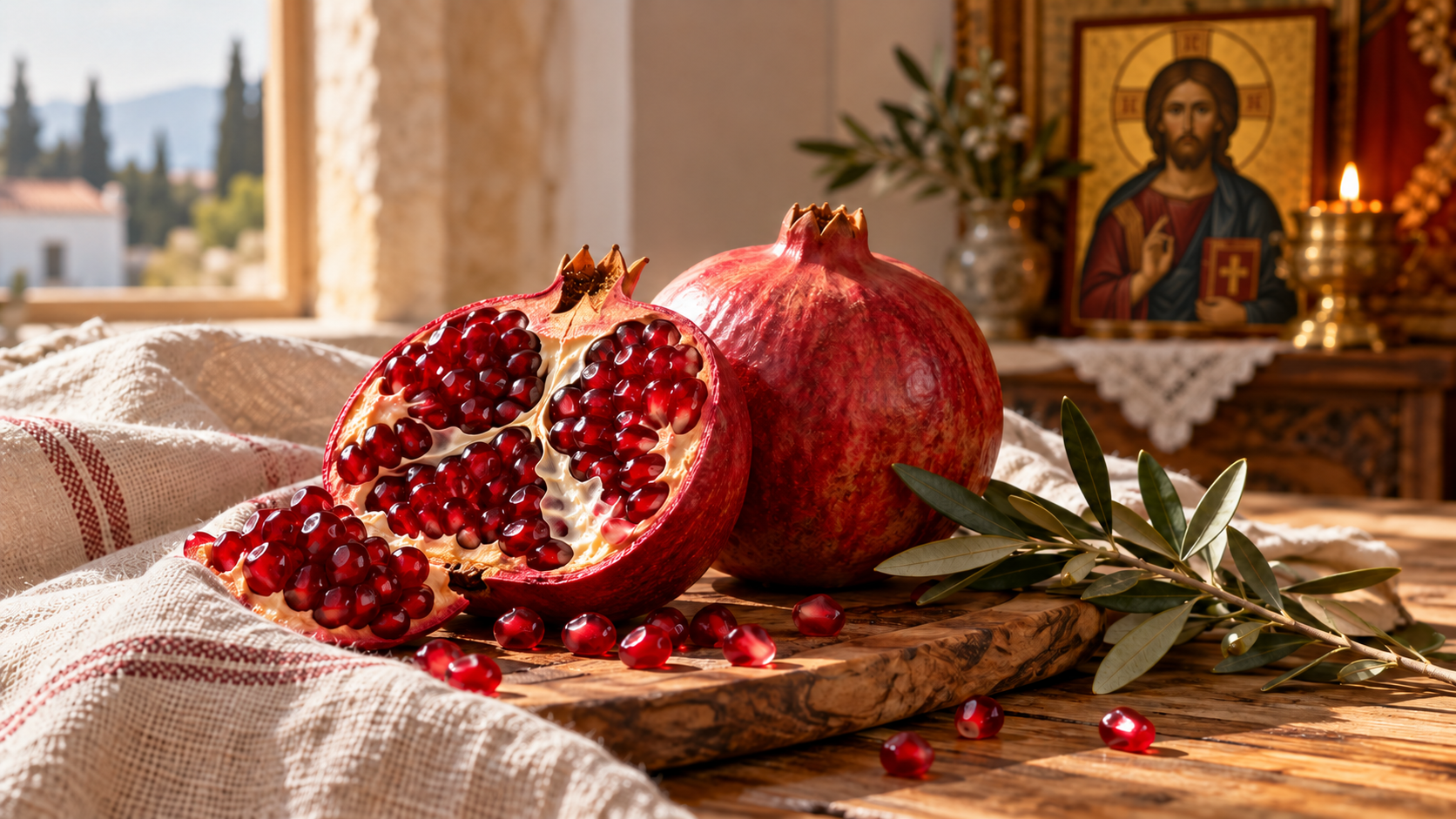
Editorial note: This article distinguishes scriptural references, Orthodox teaching, art-historical interpretation and regional customs. The featured image is an AI-generated illustration, not a photograph documenting a religious ceremony.

Explore Orthodox Christian terms for worship, icons, baptism, weddings and Greek traditions, with an alphabetical jump menu and clear, practical definitions.

7 Honest Reasons the Evil Eye Is Not Orthodox Christianity Evil eye and Orthodox Christianity confusion is more common than many people want to admit,
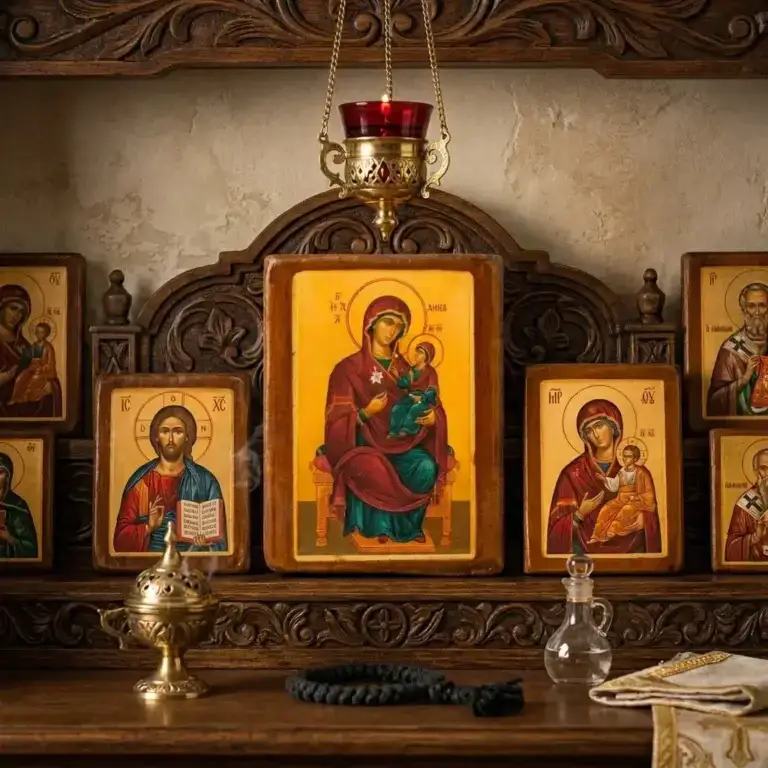
Discover how we create our Byzantine-style wooden-mounted icons in our Brooklyn workshop using solid wood, high-quality sacred imagery, the decoupage technique, and careful hand-applied finishing. Learn what makes each piece handmade and how this process differs from original hand-painted iconography.