7 Honest Reasons the Evil Eye Is Not Orthodox Christianity
Evil eye and Orthodox Christianity confusion is more common than many people want to admit, especially in Greek-American communities where culture, family habits, and faith often live very close together. In New York, we see the blue eye everywhere: on bracelets, home decor, baby gifts, keychains, wedding favors, and sometimes even attached to crosses or prayer ropes.
At The Faith Shop NY, we love Greek heritage. We love the beauty of Orthodox icons, the Cross, prayer, feast days, name days, and the living tradition of the Church. But loving heritage does not mean every popular cultural object belongs in Orthodox Christian life. For that reason, you will not find evil eye products in our online store.
This is not written to shame anyone who has worn a mati bracelet because a grandmother gave it as a gift, or because it felt familiar, pretty, or culturally Greek. Many people use it from habit, not from any conscious rejection of Christ. Still, Orthodox Christians should know what our symbols mean, where they come from, and what kind of trust they teach us to place in our hearts.
The Evil Eye Is Not an Orthodox Christian Symbol
The evil eye, also called the nazar or mati, belongs to a much older world of apotropaic objects: items believed to ward off harm, envy, bad energy, or misfortune. These beliefs existed long before Christianity and appear across Mediterranean, Middle Eastern, and Balkan cultures. The common idea is that an object, charm, bead, or symbol can protect a person from negative spiritual influence.
That may be familiar culturally, but it is not the teaching of the Orthodox Church. Orthodoxy does not teach that our protection comes from a glass eye, a blue bead, a charm, or a decorative symbol with independent spiritual power. The Christian places hope in God. We pray. We make the sign of the Cross. We venerate holy icons. We ask the prayers of the saints. We do not place our trust in superstition.
For historical background on the nazar as a protective amulet, readers can compare the cultural description of the nazar amulet with the Orthodox Christian understanding of sacred symbols explained in the Orthodox Church in America resource on Christian symbols.
Greek Culture and Orthodox Faith Are Not the Same Thing
One important distinction can clear up a lot of confusion: not everything Greek is Orthodox, and not every folk custom is theology. Greek culture is rich, beautiful, layered, and full of family memory. But Orthodoxy is not simply an ethnic aesthetic. It is the life of the Church, the confession of Christ, the sacraments, prayer, repentance, worship, and a real relationship with God.
In the diaspora, especially here in the United States, Greek identity can become condensed into a few easy symbols: the flag, blue and white colors, the evil eye, Greek key patterns, and familiar phrases. Some of those are harmless cultural motifs. But when an object is treated as a spiritual protector, the question becomes more serious. We have to ask whether it directs the heart toward Christ or away from Him.
The problem is not blue glass as a material. The problem is the meaning people attach to it. If we say, even casually, that the evil eye protects us, keeps bad energy away, prevents jealousy from harming us, or shields a child from misfortune, then we are giving a created object a role that belongs to God alone.
Why the Evil Eye Does Not Belong on Crosses or Prayer Ropes
The most troubling trend is seeing evil eye beads attached to Orthodox crosses, prayer ropes, baptism favors, and religious gifts. The Cross does not need a mati to complete it. The Cross is not a fashion charm that needs extra spiritual backup. It is the sign of Christ’s sacrifice, victory, Resurrection, and love for the world.
When the evil eye is added to a cross, the message becomes confused. Are we trusting Christ, or are we trusting a protective charm? Are we wearing the Cross as a confession of faith, or are we treating it as one more lucky object in a collection of spiritual accessories?
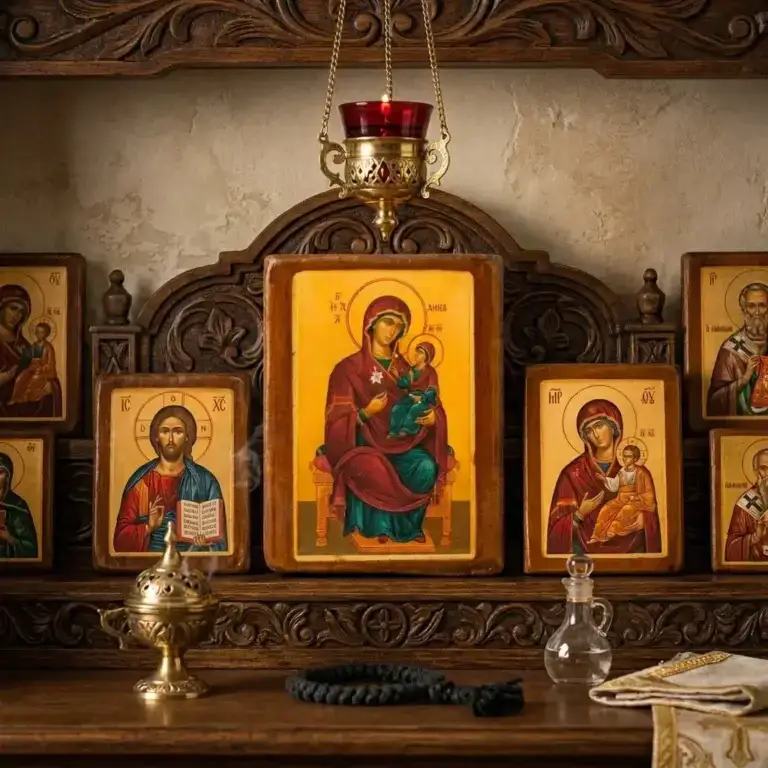
Orthodox Christians can and should wear the Cross with faith. We can keep icons in our homes, light a candle, pray, ask for a blessing, and bring our fears to Christ. None of that requires an evil eye. In fact, the evil eye weakens the clarity of the Christian witness because it mixes the language of faith with the language of superstition.
Why We Do Not Sell Evil Eye Products at The Faith Shop NY
Our store is built around Orthodox Christian gifts, Byzantine-style icons, prayerful home decor, and meaningful devotional pieces. We are not interested in selling every trend just because it is popular in Greek gift shops. We would rather be clear, reverent, and consistent.
That is why you will not find evil eye bracelets, evil eye necklaces, evil eye crosses, evil eye prayer ropes, evil eye wall decor, or evil eye charms in our online store. This is a conscious choice, not an accident. We want our products to point toward Christ, the Theotokos, the saints, the Cross, prayer, and Orthodox tradition, not toward superstition.
Faith is not superstition. Tradition is not automatically theology. A cultural habit is not automatically Church teaching. This distinction matters because symbols train the heart. What we wear, display, sell, and give as gifts teaches something, even when we do not intend it to.
Some people may say, “It is just a cute Greek thing.” Others may say, “I do not really believe in it; I just like how it looks.” That may be true for many people. But if an object’s entire cultural meaning is tied to protection from evil, envy, or bad luck, Christians should pause before treating it as harmless spiritual decor.
Orthodoxy gives us something much deeper than lucky symbols. It gives us the Cross, the Gospel, the Eucharist, confession, prayer, the lives of the saints, the holy icons, and the living worship of the Church. Compared with that, a blue charm is very small.
A Better Way to Honor Greek Orthodox Identity
If we want to honor Greek Orthodox identity in America, we do not need to reduce it to a blue bead. Greek heritage is far wider than the mati, and Orthodox Christianity is infinitely deeper than an aesthetic trend. We can teach our children about the saints. We can build prayer corners in our homes. We can celebrate name days with meaning. We can gift icons, crosses, and books that invite people into prayer rather than superstition.
This is especially important in the Orthodox diaspora. Many families are trying to preserve language, memory, food, customs, and faith all at once. That is beautiful. But the more pressure we feel to preserve identity, the more carefully we should ask what kind of identity we are preserving.
We do not need an eye to protect us. We need Christ. We do not need a charm to make the Cross stronger. We need to wear the Cross with faith. We do not need to make superstition look Orthodox. We need to let Orthodoxy be what it is: a way of life rooted in Jesus Christ.
Final Thought: Choose the Cross Over the Charm
So yes, let us stop confusing tradition with Faith. Let us stop presenting the evil eye as if it belongs naturally beside Orthodox icons, crosses, and prayer ropes. And let us stop acting as if every popular Greek symbol deserves a place in Christian devotion.
Throw away the superstition, not because we are afraid of an object, but because we choose not to place our hope in it. Put Christ in your home, in your daily life, and in your heart. Wear your Cross with faith, not as another charm. Keep icons as windows toward heaven, not as decorations of ethnic nostalgia.
Orthodoxy is not one more piece of Greek styling. It is the life of the Church. It is prayer, worship, repentance, love, and trust in Christ. We do not need an eye to guard us. We have the Lord who calls us to trust Him.
Discover how we create our Byzantine-style wooden-mounted icons in our Brooklyn workshop using solid wood, high-quality sacred imagery, the decoupage technique, and careful hand-applied finishing. Learn what makes each piece handmade and how this process differs from original hand-painted iconography.
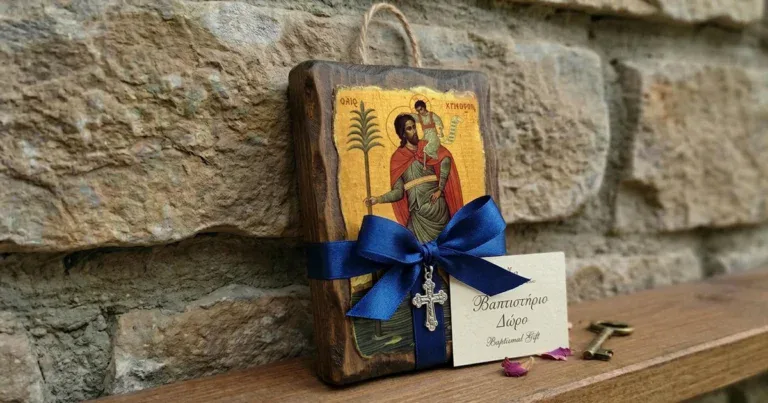
In the Orthodox tradition, a Godparent’s first gift is never just a keepsake — it’s a sacred bond expressed through faith and craft. A handmade wooden icon becomes the child’s first “window into heaven,” anchoring their prayer life from baptism through adulthood. Each piece, handcrafted on solid wood in our Brooklyn workshop, carries both spiritual weight and artisanal care, meant to endure for generations as a reminder of divine love and protection.
We use essential cookies to make this site work. With your consent, we also use analytics and marketing cookies to understand site traffic and improve our advertising. You can accept all, reject non-essential cookies, or manage your preferences.
Contains information related to marketing campaigns of the user. These are shared with Google AdWords / Google Ads when the Google Ads and Google Analytics accounts are linked together.
90 days
__utma
ID used to identify users and sessions
2 years after last activity
__utmt
Used to monitor number of Google Analytics server requests
10 minutes
__utmb
Used to distinguish new sessions and visits. This cookie is set when the GA.js javascript library is loaded and there is no existing __utmb cookie. The cookie is updated every time data is sent to the Google Analytics server.
30 minutes after last activity
__utmc
Used only with old Urchin versions of Google Analytics and not with GA.js. Was used to distinguish between new sessions and visits at the end of a session.
End of session (browser)
__utmz
Contains information about the traffic source or campaign that directed user to the website. The cookie is set when the GA.js javascript is loaded and updated when data is sent to the Google Anaytics server
6 months after last activity
__utmv
Contains custom information set by the web developer via the _setCustomVar method in Google Analytics. This cookie is updated every time new data is sent to the Google Analytics server.
2 years after last activity
__utmx
Used to determine whether a user is included in an A / B or Multivariate test.
18 months
_ga
ID used to identify users
2 years
_gali
Used by Google Analytics to determine which links on a page are being clicked
30 seconds
_ga_
ID used to identify users
2 years
_gid
ID used to identify users for 24 hours after last activity
24 hours
_gat
Used to monitor number of Google Analytics server requests when using Google Tag Manager
1 minute
SourceBuster is used by WooCommerce for order attribution based on user source.
Name
Description
Duration
sbjs_session
The number of page views in this session and the current page path
30 minutes
sbjs_udata
Information about the visitor’s user agent, such as IP, the browser, and the device type
session
sbjs_first
Traffic origin information for the visitor’s first visit to your store (only applicable if the visitor returns before the session expires)
session
sbjs_current
Traffic origin information for the visitor’s current visit to your store
session
sbjs_first_add
Timestamp, referring URL, and entry page for your visitor’s first visit to your store (only applicable if the visitor returns before the session expires)
session
sbjs_current_add
Timestamp, referring URL, and entry page for your visitor’s current visit to your store
session
sbjs_migrations
Technical data to help with migrations between different versions of the tracking feature
session
Marketing cookies are used to follow visitors to websites. The intention is to show ads that are relevant and engaging to the individual user.
Facebook Pixel is a web analytics service that tracks and reports website traffic.